How to Calculate Air Conditioner Electricity Costs
- 1. Cooling capacity is not the same as electrical power
- 2. Calculate the air conditioner’s energy use
- 3. Estimate the electricity cost
- Example: United States
- Example: European Union
- Why the two examples are not directly interchangeable
- 4. Why real-world consumption can differ
- 5. Make your estimate more useful
- 6. Conclusion
An air conditioner can make a room comfortable, but running it for several hours a day can noticeably increase an electricity bill. You can estimate the energy use and cost with a few details: the unit’s electrical input power, its operating time, and the electricity rate that applies where you live.
This guide explains the difference between cooling capacity and electrical input, shows how to calculate kilowatt-hours (kWh), and gives separate cost examples for the United States and the European Union. The figures are dated reference points, not universal tariffs.
1. Cooling capacity is not the same as electrical power
Air-conditioner specifications may show several ratings:
- Cooling capacity describes how quickly the unit removes heat from a room. It may be shown in BTU/h or kW of cooling.
- Electrical input power is the electrical power the unit draws under specified test conditions. It is usually shown in watts (W) or kilowatts (kW).
- Actual power draw changes with outdoor temperature, thermostat setting, room heat load, operating mode and compressor control.
For an electricity-cost estimate, use electrical input power—not the cooling-capacity figure. A unit rated at 9,000 BTU/h does not consume 9,000 watts of electricity.
Look for terms such as “Rated input”, “Power input” or “Rated power” on the nameplate, energy label or manufacturer’s specification sheet.
2. Calculate the air conditioner’s energy use
The basic formula is:
Energy (kWh) = Electrical power (kW) × Operating time (hours)
If the rating is in watts, divide by 1,000 to convert it to kilowatts.
For example, assume an air conditioner has an electrical input rating of 1,000 W, or 1 kW. If it runs for 8 hours a day for 30 days:
- Daily energy: 1 kW × 8 hours = 8 kWh.
- Monthly energy: 8 kWh × 30 = 240 kWh.
This is a simplified estimate that assumes the unit draws 1 kW continuously.
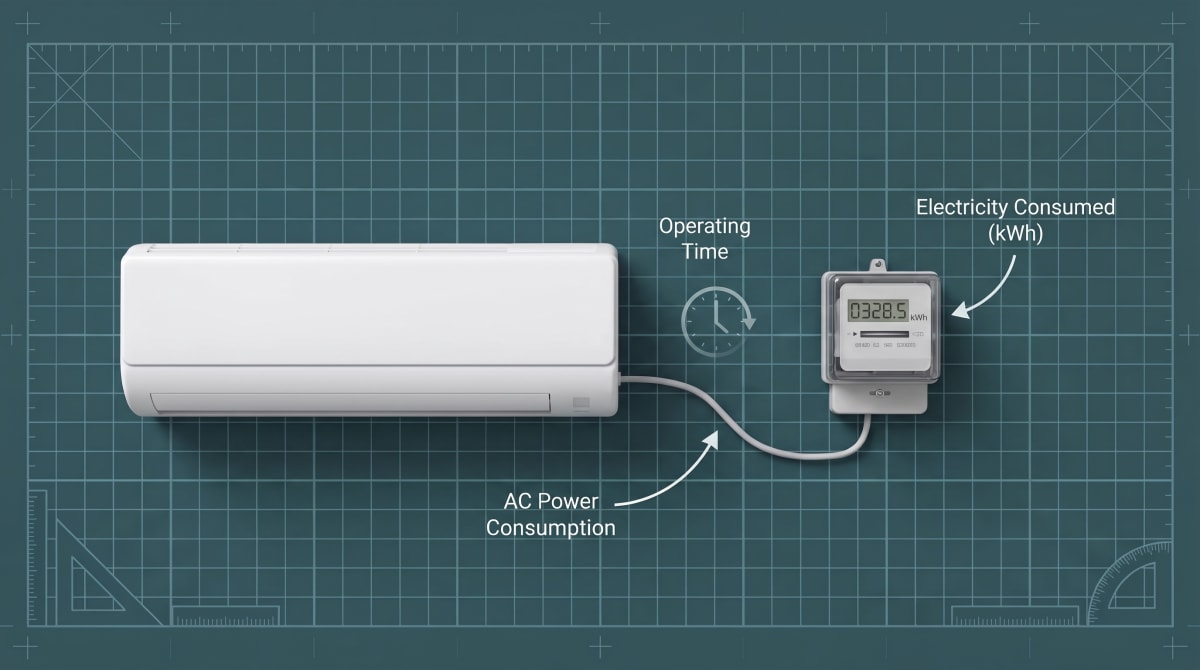
An inverter unit may vary its compressor speed and draw less or more depending on the conditions.
You can use the OmniCalc power calculator to check electrical quantities and the electricity cost calculator to estimate the cost from a kWh value.
3. Estimate the electricity cost
A simple estimate is:
Estimated energy cost = Energy use (kWh) × Electricity rate per kWh
The rate depends on the country, state or region, utility, tariff and billing arrangement. Some tariffs use time-of-use prices, tiered rates, fixed charges or additional fees. Therefore, multiplying kWh by a unit rate estimates the variable energy component; it may not equal the exact increase on a complete bill.
Example: United States
The U.S. Energy Information Administration reported an average residential electricity price of 18.16 cents per kWh for August 2026. Using that national average as a dated reference:
240 kWh × USD 0.1816/kWh = USD 43.58.
This is not a quote for every household. Electricity prices vary substantially by state, utility and rate plan. Your bill may also include fixed charges and other items.
Example: European Union
Eurostat reported an average household electricity price of EUR 0.2832 per kWh in the first half of 2026. This EU average includes taxes and levies:
240 kWh × EUR 0.2832/kWh = EUR 67.97.
The EU average is not a single tariff shared by all European countries. In the same reporting period, household prices differed considerably between member states. Your local supplier’s rate is the better input for a personal estimate.
Why the two examples are not directly interchangeable
The U.S. figure is a national residential average for August 2026, while the EU figure is a half-year average for January–June 2026 and includes taxes and levies. The periods and statistical methods are not identical. Use them to illustrate how location changes the estimate, not as a like-for-like comparison of household bills.
4. Why real-world consumption can differ
The power-times-hours formula is a useful starting point, but an air conditioner does not necessarily draw the same power throughout its operation.
- Inverter control: the compressor can slow down as the room approaches the set temperature.
- Outdoor temperature: hotter weather can increase the cooling load.
- Thermostat setting: a lower set temperature may make the unit work harder for longer.
- Room size and insulation: large rooms, poor insulation and direct sunlight can increase heat gain.
- Maintenance and airflow: dirty filters, blocked airflow or dirty heat exchangers can reduce performance.
- Usage habits: frequently opening doors or windows changes the cooling load.
If the manufacturer provides annual energy consumption or a seasonal efficiency rating, check those figures as well. They may offer a more representative comparison under a defined test method than multiplying rated input by every hour of use.
5. Make your estimate more useful
Follow these steps:
- Find the unit’s electrical input rating on its label or specification sheet.
- Estimate the average hours of operation per day and the number of days used.
- Convert watts to kilowatts, then calculate kWh.
- Use the electricity rate for your actual location and tariff.
- If your tariff is tiered, add the air conditioner’s use to the household’s existing consumption before applying each tier.
- Compare the estimate with meter readings or bills over a similar period and adjust your assumptions.
A suitable plug-in energy monitor may help measure a compatible appliance. Do not connect or install measuring equipment inside fixed electrical wiring unless you are qualified to do so.
6. Conclusion
To estimate an air conditioner’s electricity cost, start with its electrical input power—not its cooling capacity. Multiply kilowatts by operating hours to calculate kWh, then apply the rate that matches your location and tariff. A 1 kW unit running 8 hours a day for 30 days would use 240 kWh under the simplified constant-power assumption.
The amount added to your actual bill depends on the household’s existing use, tiered pricing, taxes, fees and operating conditions. Treat the result as an estimate and check your current local tariff for a more accurate figure.