How to Calculate Ladder Length Against a Wall Using the Pythagorean Theorem
- 1. When can you use the Pythagorean theorem?
- 2. Formula for calculating ladder length
- 3. Example: the ladder is 1.5 m from the wall and reaches 3.6 m high
- 4. What if you know the ladder length and the ground distance?
- 5. Common mistakes when calculating ladder length
- 6. Check your result with a Pythagorean theorem calculator
- 7. A safety note about using a real ladder
- Conclusion
A ladder leaning against a wall creates a familiar geometric shape. The ground, the wall, and the ladder form a right triangle. If you know how far the foot of the ladder is from the wall and how high the ladder reaches, you can calculate the ladder's length without measuring it directly.
This is a practical application of the Pythagorean theorem. It is useful in geometry exercises, simple measuring problems, and situations where you want to check whether a set of measurements forms a right triangle. The mathematical result, however, does not replace proper ladder selection, placement, or workplace safety procedures.
1. When can you use the Pythagorean theorem?
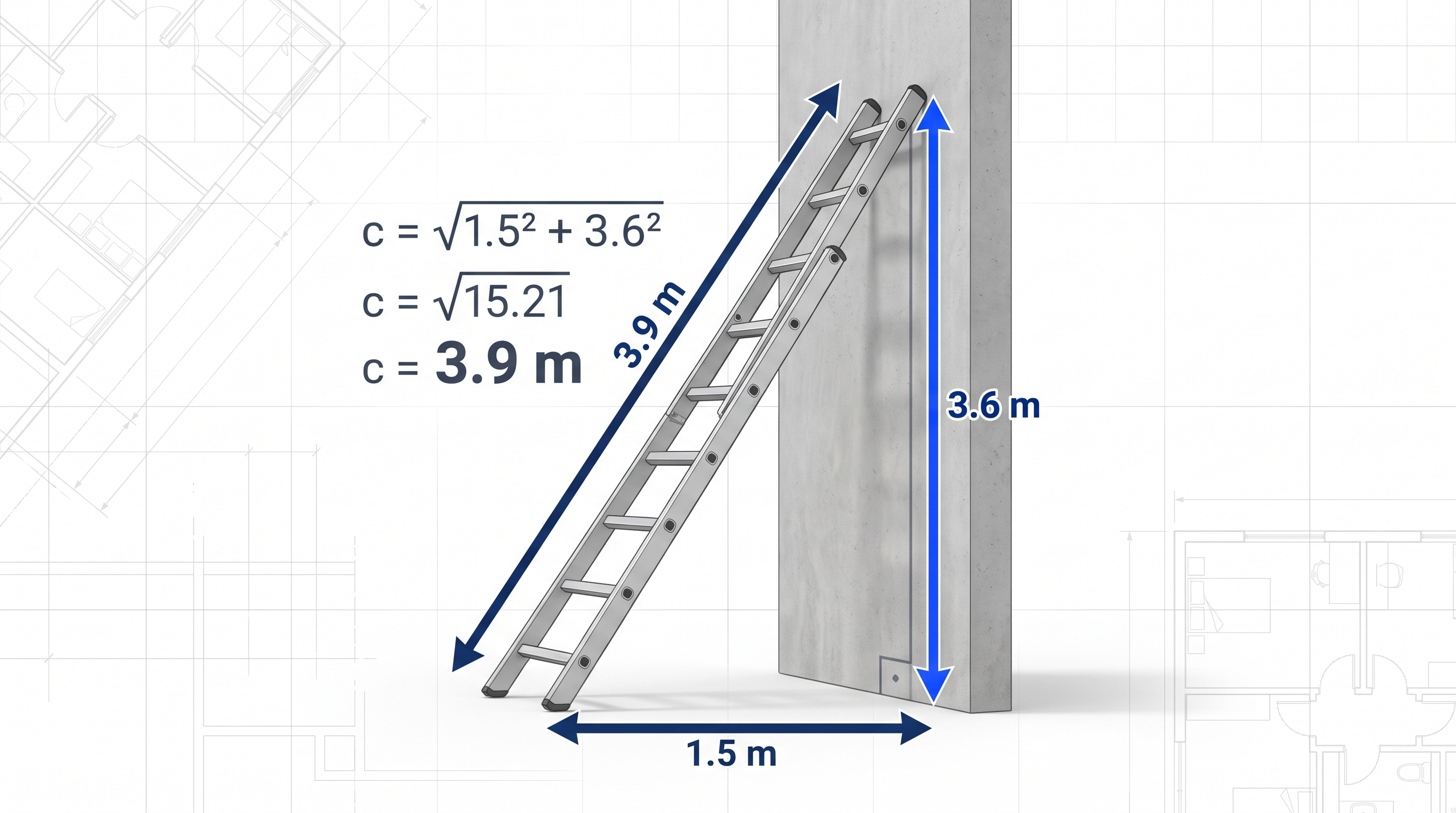
Imagine a ladder resting on level ground and leaning against a vertical wall. The foot of the ladder, the point where it touches the wall, and the corner where the wall meets the ground form the three vertices of a triangle.
In this idealized model:
- The ground is the horizontal side.
- The wall is the vertical side.
- The ladder is the sloping side connecting the two.
If the wall is perpendicular to the ground, the angle between them is 90 degrees. The shape is therefore a right triangle, and the Pythagorean theorem applies. The theorem states that the sum of the squares of the two legs equals the square of the hypotenuse. The hypotenuse is the longest side and is opposite the right angle.
Identifying the right angle is important. It is formed by the wall and the ground, not by the ladder and the wall. That means the ladder is the hypotenuse.
2. Formula for calculating ladder length
Let a represent the horizontal distance from the foot of the ladder to the wall. Let b represent the vertical height where the ladder touches the wall. Let c represent the ladder length you want to calculate.
The Pythagorean theorem is:
To find c, take the square root of both sides:
In practical terms, square the horizontal distance, square the vertical height, add the two results, and then take the square root.
*A clean technical diagram of a right triangle formed by a vertical wall, horizontal ground, and a leaning ladder. Label the base a, vertical height b, ladder c, and mark the 90-degree angle.**
3. Example: the ladder is 1.5 m from the wall and reaches 3.6 m high
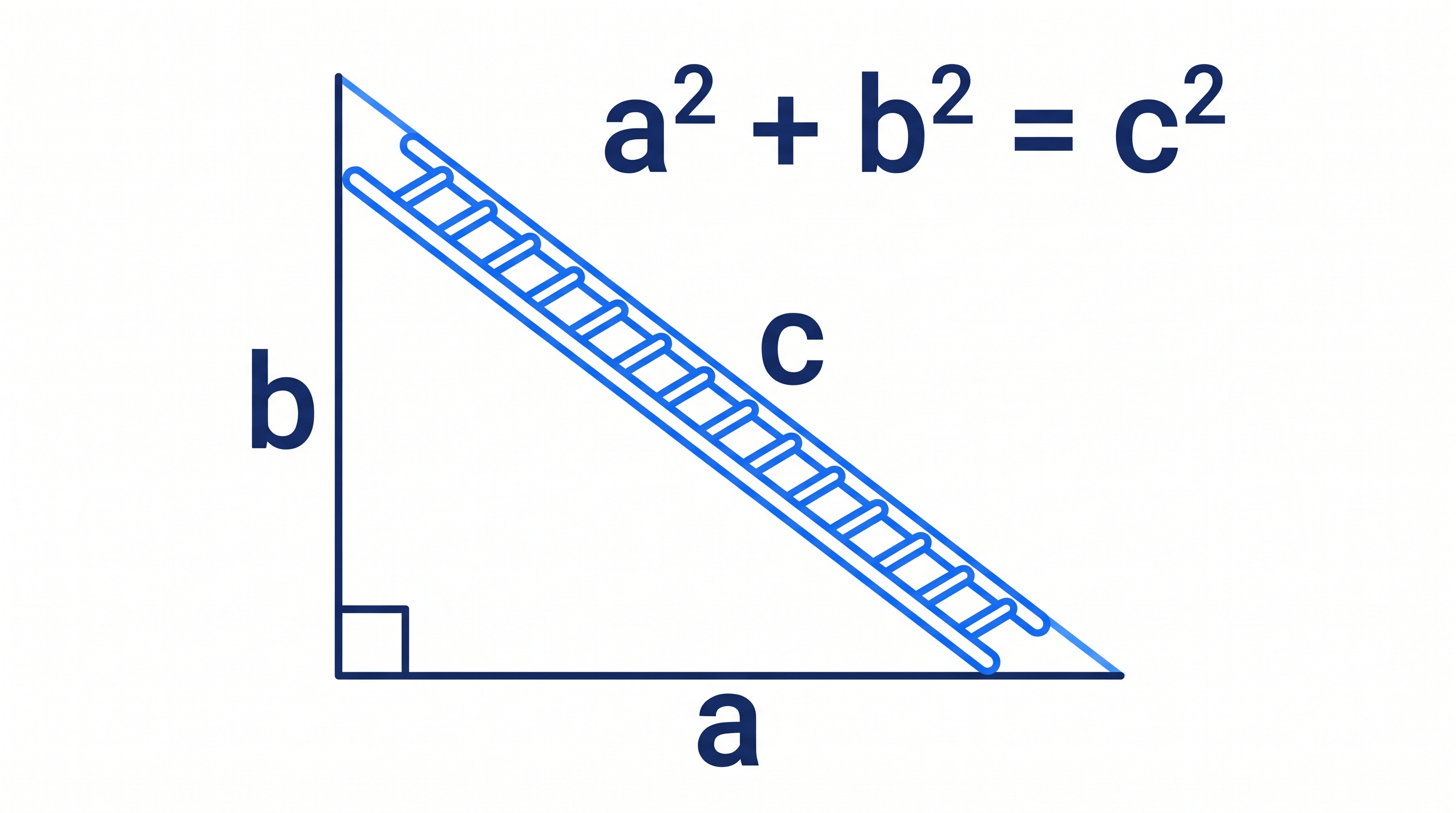
Suppose you want to calculate the length of a ladder. Its foot is placed 1.5 m from the wall, and its top touches the wall at a height of 3.6 m. Assume the ground is level and the wall is vertical.
Step 1: Write down the known measurements
- Horizontal distance: a = 1.5 m.
- Vertical height: b = 3.6 m.
- Ladder length: c = ?
Step 2: Substitute the values into the formula
Step 3: Square each measurement and add the results
The square of 1.5 is 2.25. The square of 3.6 is 12.96. Therefore:
The geometric length of the ladder is 3.9 m.
You can verify the answer by squaring 3.9. The result is 15.21, which matches the sum of 2.25 and 12.96. Checking the result this way can help you catch a typing or calculator error.
*A practical illustration of a ladder against a wall. Label 1.5 m along the ground, 3.6 m vertically on the wall, and 3.9 m along the ladder. Keep all values accurate and legible.**
4. What if you know the ladder length and the ground distance?
Sometimes you know the ladder length and how far its foot is from the wall, but you want to find the height it reaches. You can rearrange the same equation to solve for b.
Start with:
Move a squared to the other side:
Then take the square root:
For example, a 5 m ladder has its foot 3 m from the wall. The height in the right-triangle model is:
The result is 4 m. This is the familiar 3–4–5 right triangle. To check it, square 3 and 4 and add them: the result is 25, which is the square of 5.
Remember the condition: the ladder must be longer than the horizontal distance for a positive height to exist. If the distance equals the ladder length, the calculated height is zero. If the horizontal distance is greater than the ladder length, the measurements cannot form a real right triangle.
5. Common mistakes when calculating ladder length
Confusing the hypotenuse with a leg. In this model, the ladder is the hypotenuse because it is opposite the 90-degree angle. The ground distance and wall height are the two legs.
Forgetting the square root. After adding the two squared measurements, you have the square of the length, not the length itself. Take the square root at the final step.
Mixing units. If the horizontal distance is given in centimetres and the height is given in metres, convert them to the same unit before calculating. For example, 150 cm is equal to 1.5 m.
Rounding too early. If your calculator displays several decimal places, keep the unrounded value during intermediate steps and round only at the end. This helps reduce avoidable rounding errors.
Applying the theorem to a non-right triangle. The Pythagorean theorem applies directly only to right triangles. If the wall is tilted, the ground is sloped, or the angle between the two sides is not 90 degrees, this formula does not describe the geometry correctly.
6. Check your result with a Pythagorean theorem calculator
You can use the OmniCalc Pythagorean Theorem Calculator to check your calculation. When you know the two perpendicular sides, enter them to calculate the hypotenuse. If you know the hypotenuse and one leg, use the calculator to find the missing leg.
A calculator is useful when you want to test several sets of measurements, check a homework answer, or compare different values. Whether you calculate by hand or use a tool, make sure the measurements use the same unit and are suitable for a right triangle.
7. A safety note about using a real ladder
The Pythagorean calculation gives a geometric length in an idealized model. It does not tell you whether a particular ladder is suitable for a task, nor does it guarantee that the ladder has been placed safely. When using an actual ladder, follow the manufacturer's instructions and applicable workplace safety rules. Use a stable surface, inspect the ladder, and do not treat this calculation as a substitute for safety guidance or a qualified assessment.
Conclusion
To calculate the length of a ladder leaning against a wall, model the wall, ground, and ladder as a right triangle. The ladder is the hypotenuse, so its length is the square root of the sum of the squares of the horizontal distance and vertical height.
With a horizontal distance of 1.5 m and a height of 3.6 m, the result is 3.9 m. Identify the correct two sides, use consistent units, and apply the theorem to solve the problem clearly and check the result.