How to Calculate Electrical Loads for Restaurant Kitchens and Café Appliances
- How much electrical capacity does a restaurant kitchen need?
- 1. Why calculate kitchen electrical loads?
- 2. Read the appliance nameplate first
- 3. Basic current calculations
- 4. Example appliance load schedule for a small café
- 5. Why espresso machines, ovens and induction equipment need attention
- Commercial espresso machines
- Electric ovens and steam-convection ovens
- Induction cooktops and electric ranges
- Dishwashers, ice makers and refrigeration
- 6. How to decide whether a dedicated circuit is needed
- 7. Wire size depends on more than current
- 8. Check voltage drop for long cable runs
- 9. Estimate total kitchen capacity before opening
- 10. Electrical planning checklist
- Conclusion
How much electrical capacity does a restaurant kitchen need?
Planning a café, restaurant, bakery or commercial kitchen involves more than asking what wire size a single appliance needs. You must identify each appliance's voltage, rated current, phase, installation requirements and how equipment may operate at the same time.
An espresso machine, oven, induction cooktop, dishwasher and commercial refrigerator can have very different electrical characteristics. This guide explains how to create an appliance load schedule and estimate current as a starting point for a qualified electrical designer or installer.
1. Why calculate kitchen electrical loads?
A home kitchen may have a relatively limited set of appliances. A commercial café or restaurant, however, may operate several high-power appliances during a busy service period.
Typical loads to document include:
- Commercial espresso machines and coffee grinders.
- Electric ovens, convection ovens and steam-convection ovens.
- Induction cooktops, electric ranges and fryers.
- Commercial dishwashers and glasswashers.
- Refrigerators, freezers, prep tables and ice makers.
- Water heaters, hot-water dispensers and warming equipment.
- Exhaust fans, ventilation and HVAC equipment.
Do not assume every appliance needs a dedicated circuit in every installation. Check the nameplate, manufacturer installation manual and applicable code. High-load equipment, equipment specified for a dedicated circuit, or critical equipment may require separate circuits.
2. Read the appliance nameplate first
Before calculating current, collect information for the exact model. A commercial espresso machine or oven does not have one universal power rating.
Record:
| Item | What to check |
|---|---|
| Rated power (W or kW) | Manufacturer's stated input |
| Voltage (V) | For example, 120 V, 208 V, 240 V or 230 V, depending on market |
| Rated current (A) | Use the manufacturer's value when provided |
| Phase | Single-phase or three-phase |
| Frequency (Hz) | Confirm compatibility with supply |
| Circuit requirements | Dedicated circuit, receptacle, breaker or hardwiring |
| Cable route | Distance from panel to appliance |
| Environment | Heat, moisture, grease, grouping and installation method |
For motors, heating elements, compressors and electronic loads, power divided by voltage is only a simplified estimate. Actual current, power factor, starting current and manufacturer data can affect design.
3. Basic current calculations
For a simplified single-phase load:
Current (A) = Power (W) ÷ Voltage (V)
For example, a hypothetical 1,400 W appliance on a 120 V supply:
I = 1,400 ÷ 120 ≈ 11.7 A.
For AC loads where power factor matters, a simplified relationship is:
I = P ÷ (V × PF)
For a balanced three-phase load:
I = P ÷ (√3 × V × PF)
Use the correct line voltage and system configuration. Do not apply a single-phase formula to a three-phase appliance. Manufacturer-rated current should take precedence when available.
4. Example appliance load schedule for a small café
The following ratings are hypothetical examples to demonstrate arithmetic. They are not universal appliance specifications or wire-size recommendations.
| Illustrative appliance | Power | Assumed voltage | Estimated current |
|---|---|---|---|
| Espresso machine | 2,800 W | 230 V | 12.2 A |
| Coffee grinder | 500 W | 230 V | 2.2 A |
| Electric oven | 2,500 W | 230 V | 10.9 A |
| Induction cooktop | 3,000 W | 230 V | 13.0 A |
| Dishwasher | 2,000 W | 230 V | 8.7 A |
| Commercial refrigerator | 600 W | 230 V | 2.6 A |
The simple arithmetic sum is about 49.6 A if every listed load is assumed to run simultaneously under the simplified assumptions.
This does not mean the café should install a 49.6 A cable or breaker. The supply and circuits must be assessed by branch circuit, actual load characteristics, demand, simultaneity, phase distribution, installation conditions and protective-device coordination.
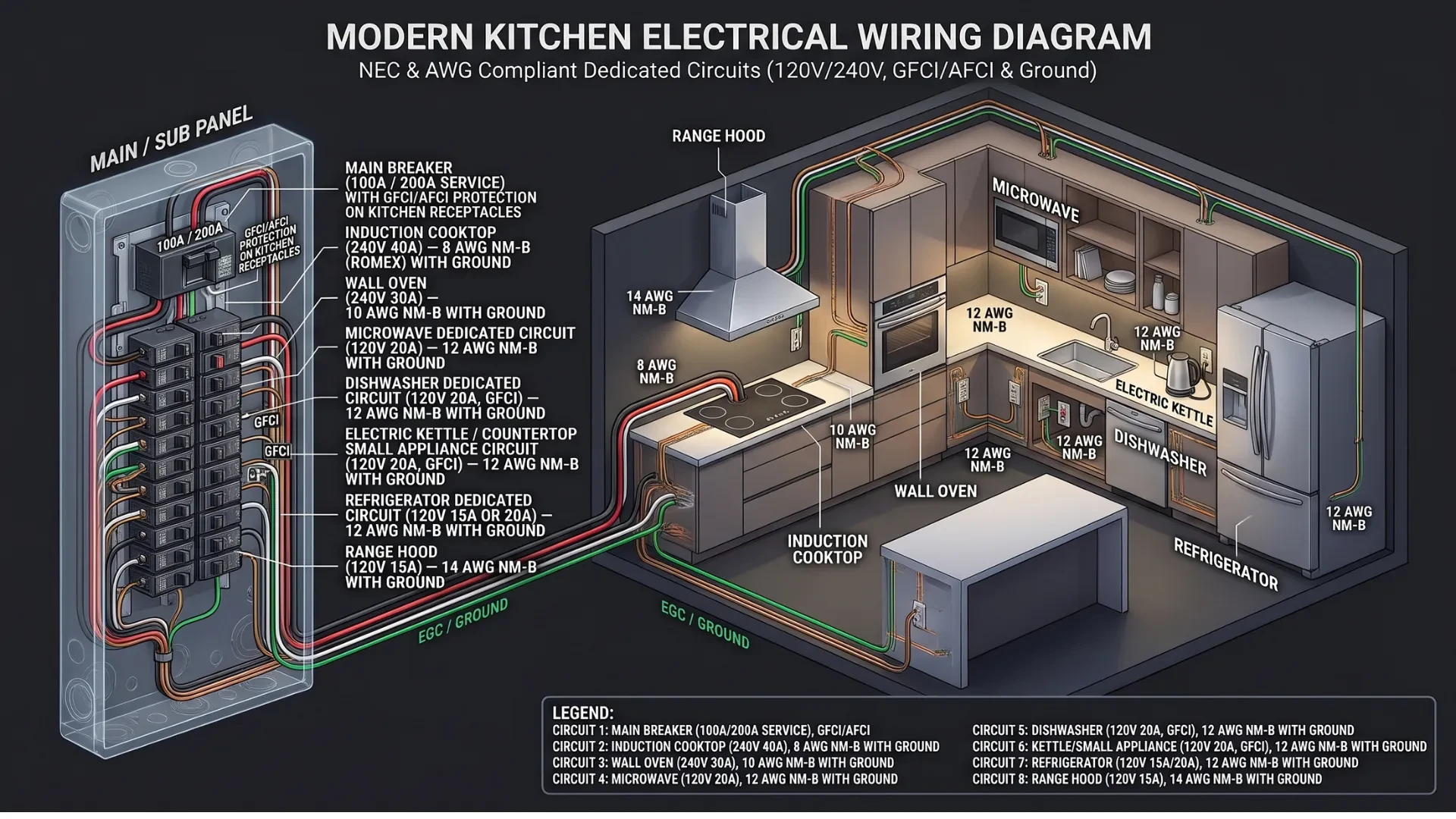
Image for illustrative purposes only.
5. Why espresso machines, ovens and induction equipment need attention
Commercial espresso machines
Espresso machines often use heating elements to heat water and maintain temperature. Depending on the model, they may have specific voltage, circuit, receptacle or connection requirements. Check rated power, voltage, current and installation instructions.
Coffee grinders are usually a different type of load, with a motor and operating cycle. Do not assume a grinder can share the espresso machine circuit simply because its wattage appears low.
Electric ovens and steam-convection ovens
Commercial electric ovens, convection ovens and steam-convection ovens may have substantial input power. Confirm the model, supply configuration, rated current and circuit requirements. Do not select conductors from kW alone.
Induction cooktops and electric ranges
Induction equipment may require a specific supply and circuit arrangement. Confirm voltage, phase, rated current and manufacturer instructions. High-power cooking equipment can significantly affect the available capacity for the whole premises.
Dishwashers, ice makers and refrigeration
Dishwashers may combine motors and heating loads. Refrigeration equipment contains compressors with operating and starting characteristics. Circuit planning should consider reliability, service isolation, equipment instructions and the consequences of an interruption.
6. How to decide whether a dedicated circuit is needed
For each appliance, check:
- Does the manufacturer specify a dedicated circuit?
- Is it a high-power heating load or a motor-driven appliance?
- Could simultaneous operation with other equipment overload a shared circuit?
- Is it critical to business operation, such as refrigeration or the espresso machine?
- Are the existing supply, receptacle, breaker and wiring suitable for the nameplate?
- Does the design need load balancing across phases or circuits?
A dedicated circuit can make isolation and maintenance easier, reduce the impact of a fault and meet installation requirements. The final decision depends on the appliance and the applicable code—not a blanket rule.
7. Wire size depends on more than current
After estimating load current, conductor ampacity must be checked for the actual installation. Factors that may reduce allowable current include:
- Wiring inside conduit, raceways or enclosed spaces.
- Multiple conductors grouped together.
- High ambient temperature in a kitchen.
- Routing near heat, steam or grease.
- Cable length and voltage drop.
- Conductor material, insulation type and wiring method.
- Short-circuit conditions and protective-device coordination.
A conductor rated for a particular current under reference conditions may not be suitable in a hot, enclosed or grouped installation. Use tables and calculation methods applicable to the actual cable and installation conditions.
8. Check voltage drop for long cable runs
Longer circuits can reduce the voltage available at the appliance. Excessive voltage drop may affect equipment performance, particularly motors or electronic devices.
The calculation may require:
- Load current.
- Cable route length.
- Conductor material and cross-sectional area.
- Single-phase or three-phase configuration.
- Cable resistance and, where relevant, reactance.
- Applicable voltage-drop limits.
Do not choose a conductor solely by current and ignore cable length. Voltage drop may require a larger conductor than the ampacity check alone.
9. Estimate total kitchen capacity before opening
Create a schedule with appliance name, model, power, voltage, phase, rated current, circuit requirements, location and proposed cable route.
Then identify which appliances could run together during peak service. Espresso machines, ovens, induction cooktops and dishwashers may overlap, while refrigerators and ice makers cycle independently. Do not apply an arbitrary diversity factor or reduce the total load without a justified basis.
This schedule helps an electrician or engineer evaluate the incoming supply, distribution panel, branch circuits, protective devices, load balancing and future expansion.
10. Electrical planning checklist
- Exact model and installation documentation are available.
- Voltage, phase, frequency and rated current are confirmed.
- Dedicated-circuit requirements have been checked.
- The load schedule and simultaneous operating loads are reviewed.
- Existing supply and panel capacity are verified.
- Voltage drop is checked for the proposed route.
- Temperature, grouping and installation method are considered.
- Grounding and overcurrent/earth-fault protection comply with applicable requirements.
- A qualified professional verifies the design against local codes.
Conclusion
For a restaurant, café or commercial kitchen, start with each appliance's nameplate, estimate current, build a load schedule, review simultaneous operation, and then verify conductor ampacity, voltage drop, protection and supply capacity.
For espresso machines, ovens, induction cooktops, dishwashers and other high-power equipment, the exact model's specifications and installation instructions are the most important starting point. There is no single wire size that fits every commercial kitchen.