Why Are Electricity Bills Rising? A 5-Country Guide to Costs and Savings
- Why Are Household Electricity Bills Getting More Expensive?
- 1. A higher bill does not always mean you used more power
- 2. Why electricity costs have faced pressure
- 3. Five countries, five different pricing stories
- 4. Calculate how much electricity your appliances use
- 5. Practical ways to lower your electricity bill
- 6. Electricity is only one part of household living costs
- Conclusion: separate energy use from the price you pay
Why Are Household Electricity Bills Getting More Expensive?
Does your electricity bill seem to rise even though your household has not bought any major new appliances? There are two basic possibilities: you are using more electricity, or the price and additional charges for each kilowatt-hour have changed. Often, both happen at the same time.
From 2023 to 2025, households in many markets continued to feel the effects of fuel-price shocks, power-system costs, exchange rates and higher cooling demand. But electricity pricing is not the same everywhere. Some countries adjust retail tariffs, some cushion customers through subsidies, and others have bills that vary by utility, region and contract.
1. A higher bill does not always mean you used more power
Everyday habits can make a difference: running an air conditioner for longer during a hot spell, using an electric water heater daily, drying clothes by machine or cooking on an electric hob. A few extra hours each day can add a substantial amount of energy over a month.
The basic estimate is:
Estimated electricity cost = energy used (kWh) × electricity rate per kWh
Actual bills may also include fixed charges, taxes, fuel adjustments, time-of-use rates, tiered pricing or government credits.
For example, a 1,000-watt appliance is a 1-kilowatt appliance. If it runs for 3 hours a day for 30 days, it uses 1 kW × 3 hours × 30 days = 90 kWh. At an illustrative rate of 20 US cents per kWh, that energy would cost 18 US dollars. This is only a worked example, not a national average or a quote for a particular utility.
2. Why electricity costs have faced pressure
Fuel costs: Many power stations still burn coal, natural gas or oil. When imported fuel becomes more expensive, the cost of generating electricity can rise. Japan's Agency for Natural Resources and Energy explains that higher imported fuel prices pushed electricity prices up in fiscal 2022; prices later eased as fuel costs fell, although that did not mean every household returned to its earlier bill. Energy in Japan 2025.
Exchange rates and imports: Countries that import coal, LNG, oil or energy equipment can face additional pressure when their currency weakens against the US dollar. The effect depends on the generation mix, fuel contracts, regulation and how quickly costs are passed through to customers.
Weather and peak demand: Heat waves increase the use of air conditioning and refrigeration. During periods of high demand, power systems may need more expensive generation, reserve capacity or investment in transmission and distribution networks.
The grid and non-generation charges: Electricity must be transmitted, distributed, metered and maintained before it reaches a home. A bill therefore covers more than the electricity purchased from generators. In Meralco's service area in the Philippines, its 2025 average bill breakdown was approximately 64% generation, 12% distribution, 8% transmission, 5% system loss and 11% other charges. This is Meralco's breakdown, not a national breakdown for every Philippine utility. Meralco – Understand Your Bill.
3. Five countries, five different pricing stories
Do not compare a national average with a single utility's rate or a generation-only charge. The figures below show trends and pricing mechanisms; they are not a simple ranking of the most expensive country.
| Country | Useful evidence | What it means |
|---|---|---|
| United States | Average residential electricity prices were 16.00 cents/kWh in 2023, 16.48 cents in 2024 and 17.23 cents in 2025. | EIA data imply an increase of about 7.7% from 2023 to 2025. Actual bills vary by state, utility and plan. |
| Japan | The Agency for Natural Resources and Energy reported that the average household electricity unit price in FY2023 was about 35% above FY2010; prices had eased from their peak as imported fuel prices declined. | Bills can reflect fuel-cost adjustments, the renewable-energy surcharge, tax and temporary support programmes. |
| Vietnam | The average retail electricity price rose from VND 2,103.12/kWh to VND 2,204.064/kWh on 10 May 2025, excluding VAT. EVN reported four average-price increases since early 2023 by that date. | This is an average retail price, not the final price for every household usage tier. Residential customers should check the applicable tariff schedule. |
| Philippines | The Energy Regulatory Commission reported that the national average annual generation rate fell from PHP 7.50/kWh in 2023 to PHP 6.64 in 2024; the 2022 average was PHP 8.00. | Generation is only one part of the bill. Meralco's average residential retail rate was PHP 11.86/kWh in 2023, PHP 12.14 in 2024 and PHP 13.42 in 2025. |
| Indonesia | The government kept many electricity tariff groups unchanged during several quarters in 2023 and early 2025; non-subsidised tariffs are reviewed periodically using economic indicators. | The amount a household pays depends on its customer category, installed capacity, subsidy eligibility and the policy in force. |
Sources: EIA – Average Price of Electricity, Japan Agency for Natural Resources and Energy – Energy in Japan 2025, EVN – May 2025 retail price adjustment, Philippines ERC – 2024 generation-rate analysis, Meralco – 2025 Integrated Report, PLN – Tariff Adjustment.
4. Calculate how much electricity your appliances use
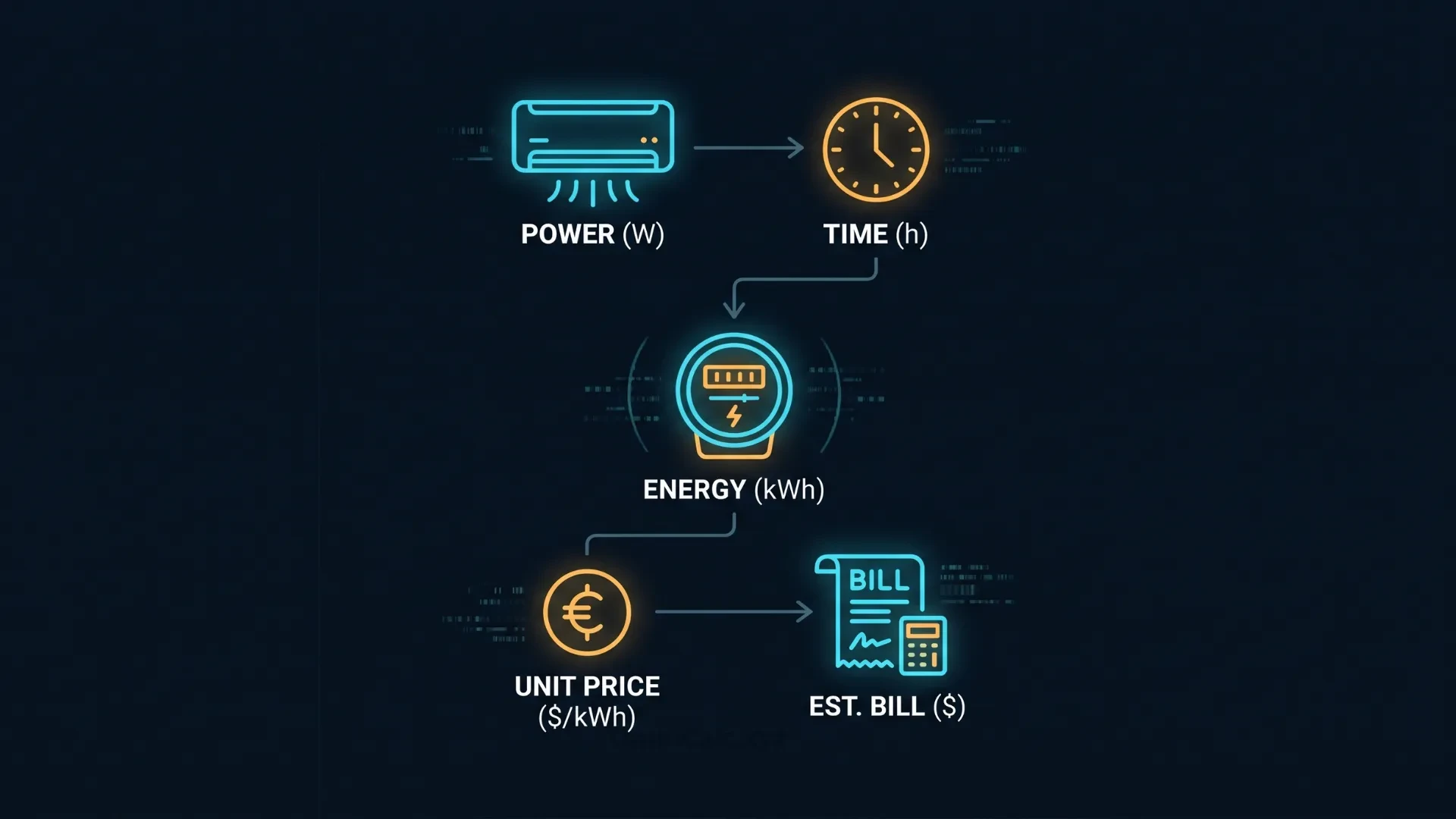
Check the rated power on an appliance label. The basic formula is:
Energy (kWh) = power (W) ÷ 1,000 × operating hours
Illustrative monthly examples:
| Appliance | Assumed power | Usage | Energy |
|---|---|---|---|
| Air conditioner | 900 W | 8 hours/day × 30 days | 216 kWh |
| Water heater | 1,500 W | 1 hour/day × 30 days | 45 kWh |
| Desktop computer | 250 W | 5 hours/day × 30 days | 37.5 kWh |
| Rice cooker | 700 W | 1 hour/day × 30 days | 21 kWh |
These examples assume the stated power draw continues throughout the usage period. Thermostats, inverter compressors and automatic cycles can make actual consumption lower or different.
Enter each appliance's power and usage time in Brain Lore's Energy Cost calculator to estimate kWh and cost. Use the rate on your own bill rather than assuming one online price applies to every household.
5. Practical ways to lower your electricity bill
- Air conditioning: Keep doors and windows closed, clean filters, block direct sunlight and choose a sensible set temperature.
- Refrigerators: Avoid leaving the door open, allow airflow around stored food and check the door seal.
- Water heating: Reduce unnecessary hot-water use and avoid heating water when it is not needed.
- Laundry: Run full loads when practical, use efficient cycles where suitable and air-dry clothes when conditions allow.
- Standby power: Turn off devices that do not need to remain powered, while keeping essential equipment connected according to the manufacturer's instructions.
- Track kWh, not just money: If the bill rises while consumption is stable, check the tariff, taxes, fuel adjustments and other line items.
Record monthly kWh for three to six months. Seasonal increases may point to cooling or heating use. If consumption is stable but the total rises, the cause may be the rate or other bill components.
6. Electricity is only one part of household living costs
Electricity is one item in a household budget. Higher energy, fuel and transport costs can also put pressure on the prices of some goods and services, but it would be misleading to attribute every increase in the cost of living to electricity alone.
If a bill or offer includes a discount, VAT or a before-tax/after-tax amount, Brain Lore's Discount & VAT calculator can help separate the discount, tax and final total. It performs the arithmetic; the applicable tax rate and rules must still come from the bill or local regulations.
Conclusion: separate energy use from the price you pay
A higher bill can come from greater consumption, a higher unit rate or additional adjustments. Start by separating two things: how many kWh you use and how much each kWh costs. Once you know which appliances consume the most and how your tariff works, you can choose savings that fit your household without cutting comfort unnecessarily.